Algiers
Home |
How to play |
FAQ |
About
How to play Algiers?
Game Objective:
The primary goal in Algiers Solitaire (also known as Algerian Patience) is to move all cards from the tableau, reserve, and stock onto the eight foundation piles, building each foundation completely according to its suit and sequence.
Setup & Layout:
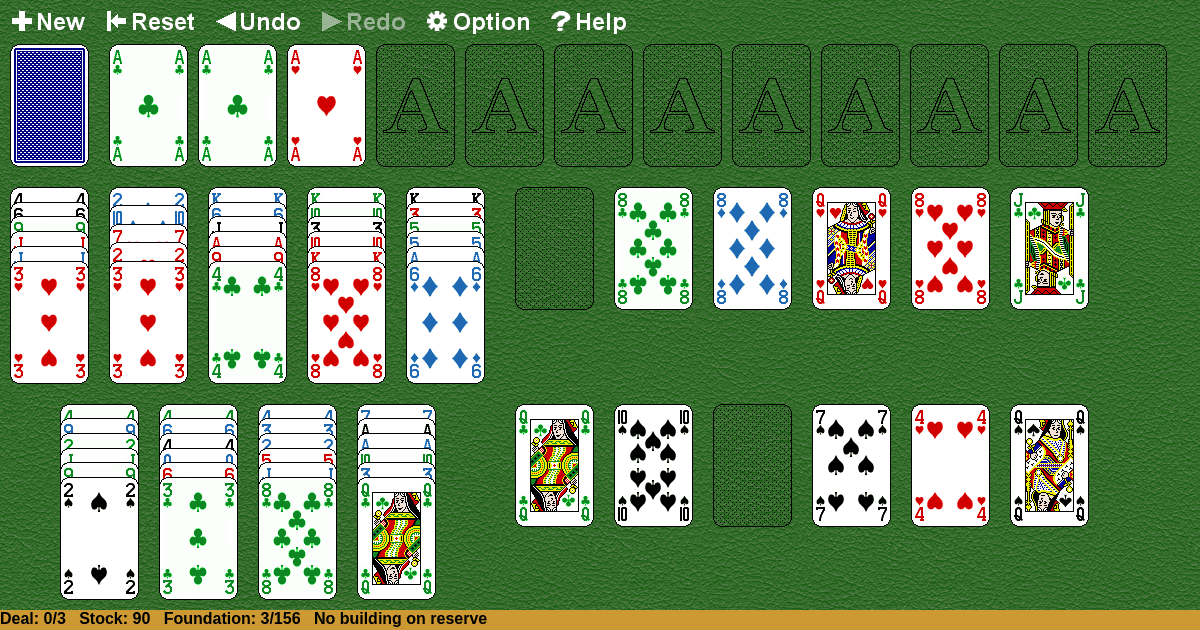
- Deck: Two standard 52-card decks (104 cards total).
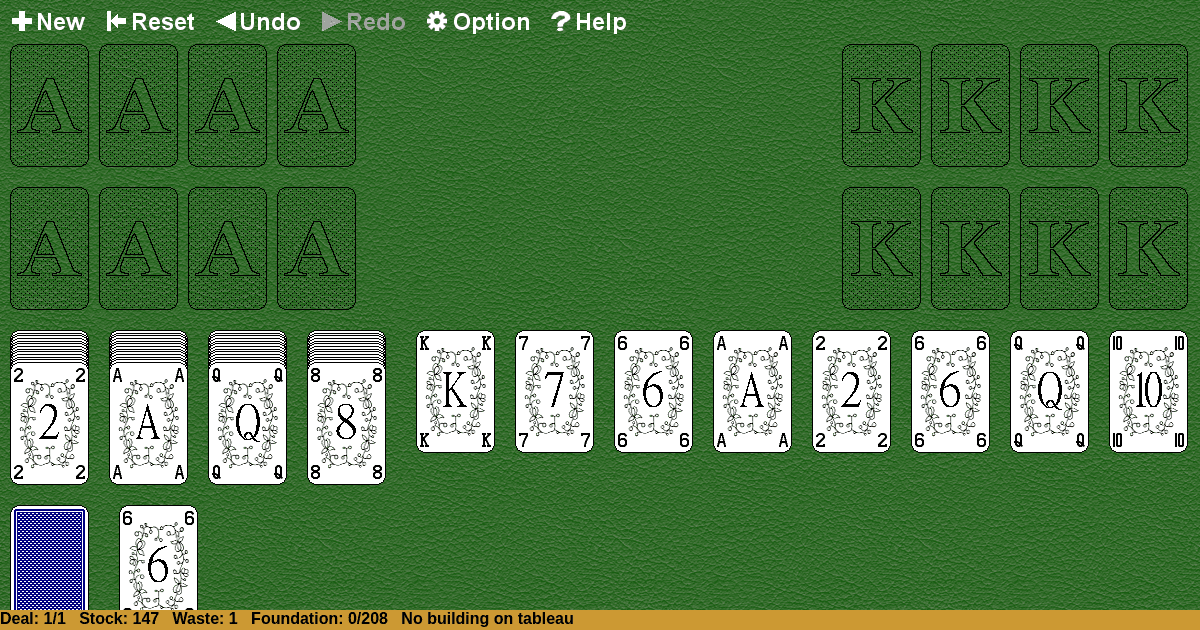
- Foundations: Eight foundation piles at the top of the play area.
- Four leftmost foundations start with an Ace of each suit (built up in suit: Ace → King).
- Four rightmost foundations start with a King of each suit (built down in suit: King → Ace).
- Some versions deal the Aces and Kings to the foundations at setup; others require them to be played as they appear.
- Tableau: Eight tableau piles (also called depots or stacks) arranged in a row below the foundations.
- Each tableau pile starts with one face-up card.
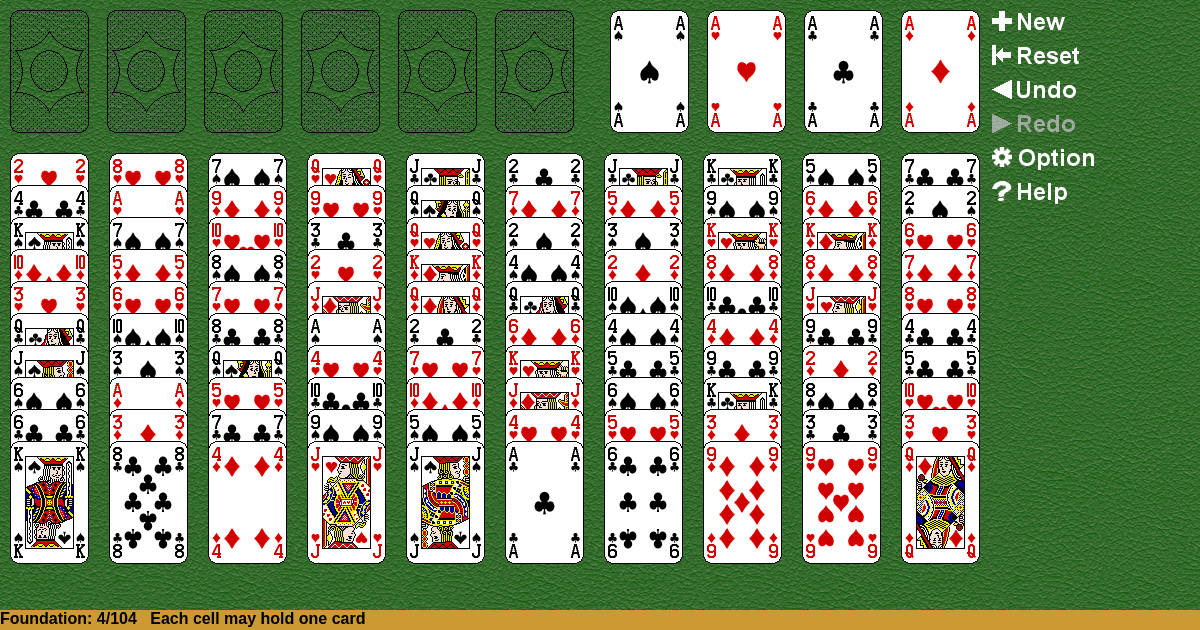
- Reserve: Six reserve piles, each with four face-up cards dealt at the start.
- Stock: The remaining cards form the stock pile, used for future deals.
- Face Orientation: All cards in tableau and reserve are dealt face up; stock cards are face down until dealt.
Algiers Solitaire Rules:
- Foundations:
- Aces Foundations: Build up in suit from Ace to King (A♠, 2♠, 3♠, …, K♠).
- Kings Foundations: Build down in suit from King to Ace (K♥, Q♥, J♥, …, A♥).
- When the up and down foundations of the same suit meet, cards may be transferred between them if needed.
- Tableau Building:
- Build up or down in suit (e.g., 5♦ on 4♦ or 6♦; 6♠ on 5♠ or 7♠).
- Building direction can change at any time.
- Wrapping: Kings can be placed on Aces and Aces on Kings (sequence wraps).
- Only the top card of each tableau pile is available for play.
- Reserve Rules:
- Only the top card of each reserve pile is available.
- Reserve cards can be moved to tableau or foundations, but not to other reserve piles.
- Movement:
- Only one card may be moved at a time (no sequences).
- Cards may be moved from reserve or tableau to foundations or tableau, but not from tableau/reserve to stock or reserve.
- Empty Spaces:
- Any exposed card may fill an empty tableau pile.
- Reserve piles may not be filled once emptied in most versions.
Gameplay:
- Turn Sequence:
- Move exposed cards from tableau or reserve to foundations or tableau, following building rules.
- Continue making moves until no further moves are possible.
- Dealing from Stock:
- When stuck, deal two cards from the stock to each reserve pile (face up).
- On the final deal from the stock, deal one card to each tableau pile instead of the reserve.
- No More Moves:
- If no legal moves remain and the stock is exhausted, the game ends.
- If stock remains, deal as described above and continue play.
Winning & Losing Conditions:
- Win: The game is won when all 104 cards are moved to the eight foundation piles, each completed in correct suit sequence (Ace to King or King to Ace).
- Lose: The game is lost (unwinnable) if no further legal moves can be made and the stock is depleted, with cards remaining in tableau or reserve.
Special Rules & Edge Cases:
- Filling Empty Tableau: Any exposed card (from tableau or reserve) may fill an empty tableau pile.
- Filling Empty Reserve: Most versions do not allow refilling reserve piles once emptied. Some variants allow a single card to be moved to an empty reserve pile, but this is rare.
- Foundation Transfer: If the up and down foundations of the same suit meet (e.g., the Ace-to-King and King-to-Ace piles converge), cards may be transferred between them as needed.
- Wrapping Sequences: Sequences in the tableau may wrap around (King follows Ace and vice versa).
- Single Card Moves: Only one card may be moved at a time; building or moving sequences is not permitted.
- Reserve Play: Reserve cards can only be played to tableau or foundations, never to other reserve piles or the stock.
- Stock Dealing: Each deal from the stock must be made to all reserve piles (two cards each), except for the final deal, which goes to the tableau (one card each).
This guide provides a precise, step-by-step framework for playing Algiers Solitaire, strictly adhering to the variant’s unique ruleset and terminology.
Solitaire Collection










Frequently Asked Questions
-
What is the objective of Algiers (Algerian) Solitaire?
The objective is to move all cards to the eight foundation piles: four built up in suit from Ace to King, and four built down in suit from King to Ace.
-
How is the initial layout set up in Algiers Solitaire?
There are eight tableau piles, six reserve piles (each with four or six cards depending on the rules), and eight foundation piles. The tableau and reserve piles are dealt face up, and the rest of the cards form the stock.
-
How do you build on the tableau in Algiers Solitaire?
Cards on the tableau can be built up or down in suit, and you can reverse direction at any time. Only one card can be moved at a time, and wrapping from King to Ace (and vice versa) is allowed.
-
What are the rules for the reserve piles?
Only the top card of each reserve pile is available for play to the tableau or the foundations. You cannot move cards back to the reserve. Empty reserve piles usually cannot be filled.
-
How do you deal new cards from the stock?
When no moves are possible, deal two cards from the stock onto each reserve pile. For the final deal, one card is dealt to each tableau pile.
-
Can you move sequences of cards or only single cards?
Only single cards can be moved at a time; sequences cannot be moved together.
-
What happens when a tableau pile becomes empty?
An empty tableau pile can be filled with any exposed card from the tableau or reserve.
-
Is there a redeal in Algiers Solitaire?
No, there is no redeal. Once the stock is exhausted, you cannot reshuffle or redeal the cards.
-
Are there any special rules for moving cards between foundations?
When the up and down foundations of the same suit meet, cards can be transferred between them to complete the suit.
-
How difficult is Algiers Solitaire and what strategies help?
Algiers Solitaire is considered very challenging. Creating empty tableau columns early and careful management of reserve cards are key strategies for success.